


 Free Newsletter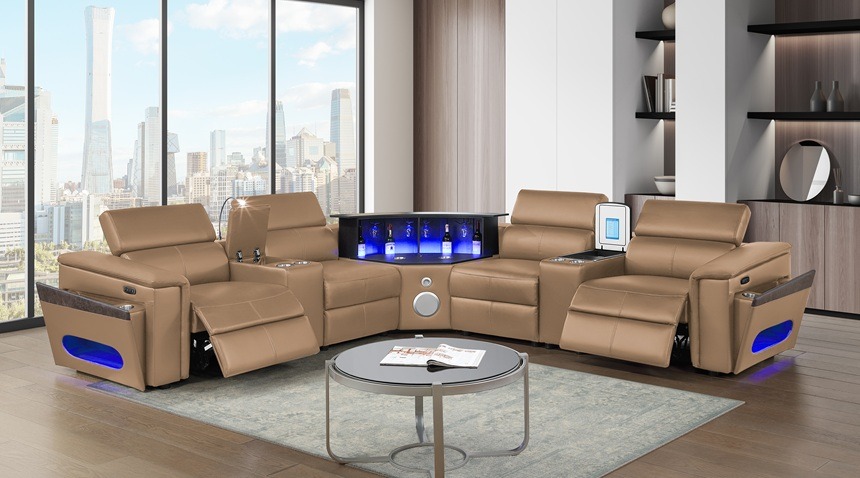
Matrix Furniture attributes much the company’s growth to innovation. The Nova sectional, for example, features a pop-up bar, refrigerator, immersive sound, lighting and a built-in charging station.
Escaping the Matrix | Ray Allegrezza
Ray Allegrezza //Editor Emeritus, Furniture Today//June 5, 2026


If there is one complaint I hear more than any other these days, it’s that consumers aren’t buying furniture the way they used to.
My response is always the same: Of course they aren’t.
The world isn’t the same as it was 10 years ago, much less 30 years ago. Consumers have changed. Technology has changed. The way people shop, research, compare and ultimately buy has changed. Yet too much of the furniture industry continues to operate as if none of that happened.
That’s one reason I found my recent conversation with Rajeev Bedi, president of U.S. operations for Matrix Furniture Group, so interesting.
At a time when many furniture manufacturers are happy to report flat sales and others are struggling to maintain volume, Matrix continues to grow. Bedi doesn’t attribute that success to luck, favorable geography or some secret formula. He believes it comes down to a willingness to innovate while others continue selling the same products they sold years ago.
See also:
- A dead car, a running story and a lesson furniture can’t afford to miss | Ray Allegrezza
- Same sofa, different price. And you’ll never see the difference | Ray Allegrezza
“The customer has changed,” Bedi told me. “The demographics have changed. The buying habits have changed.”
Simple enough. Yet many retailers and suppliers continue to fight that reality.
Today’s consumers, particularly those under age 40, can scroll through thousands of products on their phones before breakfast. They can compare prices, styles, features and reviews with a few taps. If they decide to visit a furniture store, they’re looking for a reason to make the trip. Too often, they don’t find one, Bedi maintains.
Bedi, who spent years in retail before moving to the manufacturing side, believes many stores are still showing assortments that would have looked familiar a generation ago. “I go into a lot of stores and see very bland furniture,” he said. “Furniture that was selling 30 years ago.”
Whether retailers want to hear it or not, consumers’ tastes have evolved. Social media has exposed them to design ideas from around the world. Technology has become part of nearly every aspect of their daily lives. They expect products to do more than they once did.
Bedi learned that lesson the hard way. Like many entrepreneurs, he admits he initially bought products he personally liked and assumed consumers would feel the same way. That proved to be an expensive education.
“I bought what I liked and brought it in hoping it would sell,” he said. “Then I had to clear all that inventory. That’s when I started asking what my customer wanted.”
That shift in thinking changed everything. He began asking how consumers lived. What frustrated them? What could make their homes more comfortable, more entertaining and more functional? The answers led Matrix down a path that many traditional furniture companies might have considered risky.
One of the company’s biggest successes is a sectional that incorporates a refrigerator, wireless charging, wine storage and a motorized pop-up bar. When Bedi first unveiled it, competitors laughed. “They asked, ‘Who’s going to buy this?'” he recalled.
Apparently, quite a few people. Today, that product category generates roughly 7% to 8% of Matrix’s annual revenue. Even more telling, Bedi says several competitors have since introduced their own versions after initially dismissing the concept.
The same approach is driving innovation in the company’s bedroom category.
Matrix recently introduced a bed featuring immersive sound technology, integrated surround-sound speakers and a built-in 4K projector capable of turning virtually any bedroom wall into a home theater screen.
Another model includes motion-activated under-bed lighting that illuminates the floor when users get out of bed at night. Yet another incorporates built-in phone holders and charging stations designed for consumers who spend hours streaming content while lying in bed.
Bedi’s newest project may be his most ambitious yet: a sofa that combines a refrigerator, a pop-up bar, karaoke capability and directional speakers that allow users to hear television audio clearly without disturbing others in the room. The speakers can be aimed toward the listener, creating a more private listening experience without forcing everyone else in the room to endure the volume.
Whether every idea becomes a runaway success is almost beside the point. The larger lesson is that Matrix is actively looking for ways to make furniture do more than it did yesterday.
Consumers don’t think in industry categories. They don’t wake up wondering whether they want furniture, electronics or home entertainment. They simply want products that improve their lives. The most successful companies are figuring that out.
What’s particularly interesting is that Bedi isn’t abandoning furniture fundamentals. He still believes in the classic good-better-best strategy. The difference is that he uses innovation to create meaningful separation between those tiers.
Consumers still have entry-level options. They still have mid-priced choices. They still have premium offerings. But each step up delivers something noticeably different and more compelling. “You have to give people reasons to upgrade,” he said. “You have to offer something they can’t find online.”
That may be the most important sentence in this entire conversation.
For years, retailers have worried about competing with the Internet. Too often, the response has been to fight online sellers on price. That’s a battle most stores can’t win.
A far better strategy is to offer products consumers can’t easily comparison shop, products that create excitement, products that generate conversation and products that make shoppers say, “I’ve never seen that before.”
Of course, none of this works if retailers refuse to take a chance. Furniture merchants, by nature, tend to be cautious. They don’t like inventory mistakes and they don’t like risk. That’s understandable.
But innovation rarely arrives with a guaranteed sales history. Someone has to go first.
According to Bedi, that’s becoming less of a challenge because retailers now come to Matrix’s showroom expecting to see something different. Over time, trust has replaced skepticism. Retailers know they may not embrace every idea, but they also know they won’t see the same old thing.
There was another point Bedi made that resonated with me: Too many people are still measuring today’s business against the extraordinary years of the pandemic. That’s a dangerous benchmark.
“Business isn’t bad,” he said. “Business is normal.”
Many industry participants would agree. The industry experienced a once-in-a-generation surge. Those numbers were never going to last forever. Companies that continue chasing their COVID peaks may spend years feeling disappointed. Companies focused on gaining market share, improving products and serving customers better will be far healthier in the long run.
Bedi also deserves credit for another decision that often gets overlooked. While many suppliers chase only the largest accounts, Matrix built its business by taking small retailers seriously. Today the company serves roughly 4,000 accounts from distribution centers in New Jersey and California, creating a broad customer base that isn’t dependent on a handful of giant retailers.
“A big customer loses a sale, it’s a number,” he said. “A small customer loses a sale, that’s a bill they could have paid.” That’s a philosophy many suppliers would do well to remember.
At the end of the day, however, this story comes back to innovation. Not innovation for innovation’s sake. Not gimmicks. Not technology bolted onto furniture simply because it can be.
Real innovation begins with understanding how consumers live today and then building products around those realities. That’s what Bedi and Matrix Furniture Group are doing.
And while much of the industry continues debating why traffic is soft, they’re giving consumers new reasons to walk through the front door.


