


 Free Newsletter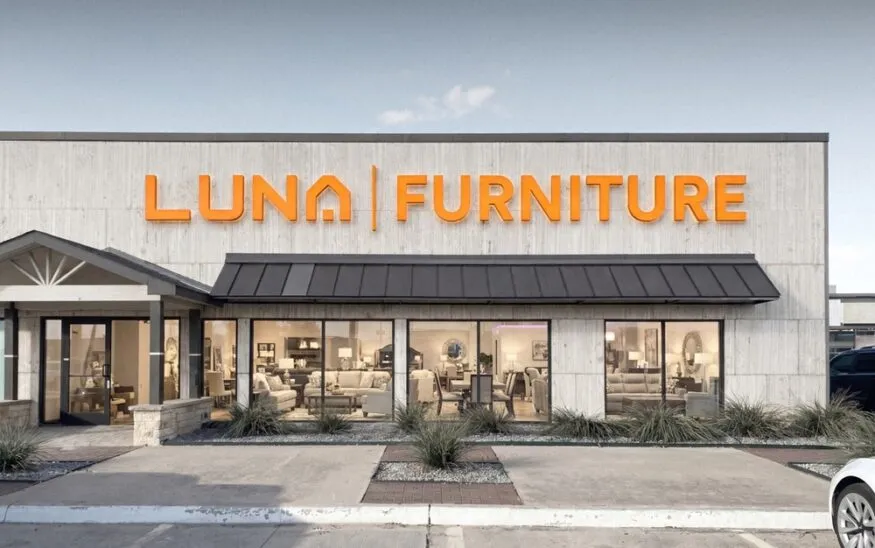
In 10 years, Luna Furniture has grown from a single Houston location to four stores and a nationwide e-commerce operation. Image courtesy of Luna Furniture.
A national footprint from 4 stores? What you might be missing | Bill McLoughlin
Bill McLoughlin //Editor in Chief//June 6, 2026


There’s a story in this week’s issue about a Houston furniture retailer named Lunathat could be instructive for furniture retailers looking to compete in today’s digitally disrupted retail environment.
It’s not dramatic. It doesn’t involve disruptive technology that’s upending the marketplace. Instead, it quietly describes a playbook that any serious furniture retailer could study and apply if they have ambitions beyond their ZIP code.
Luna Furniture, now 10 years old, started in a warehouse in Stafford, Texas. Today it operates four retail locations plus four regional warehouses that allow it to ship furniture to any of the 48 contiguous U.S. states.
See also:
- Top 100 shines spotlight on increasing retail polarization | Bill McLoughlin
- Watson’s didn’t just expand; it chose a different way to grow | Ray Allegrezza
You read that correctly. A four-store independent furniture retailer that competes and serves customers in the 48 contiguous states. By any measure, that’s a noteworthy accomplishment. But what’s as interesting as the growth itself is how it got there. And what’s even more important is that its model is replicable.
Luna figured out early on that the physical store and the digital presence are not competing strategies; they’re complementary ones. Too many dealers still treat e-commerce as a tool to serve local customers and whose primary purpose is to drive a footstep through the door.
Instead, Luna built its digital operation as the engine of national reach, with the stores and warehouses serving as the infrastructure that makes that reach credible and deliverable. That sequencing matters. The website doesn’t just market the brand; it is the brand for most of Luna’s customers.
The national logistics infrastructure is the piece that most retailers don’t consider. It’s relatively easy to stand up a website. It is genuinely hard to fulfill a sectional sofa in Maryland from a warehouse in Texas with consistency.
Luna solved this by building a regional warehouse network — California, Texas, Illinois, Maryland, with Florida on the way — that allows it to compress delivery times and serve customers who have never set foot in one of its stores. That is not a small investment, and it is not an accident. It is a strategic decision to treat logistics as a competitive advantage.
That comes with its own challenges, not the least of which is cost. Luna doesn’t hide shipping costs inside product prices and advertise “free delivery.” It prices product competitively and separates out delivery costs. Transparency in this case is not just ethical, it’s practical.
As it has grown, the company also has become more focused on market segmentation. Luna Furniture’s newest location, opened in Virginia last October, targets affluent buyers seeking contemporary design, a different customer than Luna was serving in Houston and Dallas. The simultaneous launch of a “Luna Premium” selection on its website shows it understands that expanding reach isn’t just about geography; it’s about learning to speak to different customers with different needs.
The furniture industry has no shortage of retailers that are very good at serving their home market. What Luna has demonstrated is that driving a customer into a physical location is not the only way to compete today. It also demonstrates that competing online, across a national footprint, doesn’t necessarily require physical locations or Amazon-like scale.
At time when many dealers are struggling to keep pace with changing market dynamics, it’s a model that deserves consideration.


